
Record the full purchase obligation when you agree to the plan, then list every installment date and amount. Reserve the unpaid balance or create a category that holds each installment before it is withdrawn. A small first payment does not make the remaining obligation disappear.
Forum discussions often focus on whether an interest-free installment is mathematically harmless. The practical failure point is stacking several plans until their biweekly withdrawals compete with rent, groceries, or another card payment.
Start here: a practical action plan
- Write down the full purchase price and every installment date before agreeing.
- Combine all providers in one calendar or spreadsheet.
- Reserve the unpaid balance or fund every installment before its due date.
- Keep return and plan confirmations until the revised schedule is final.
- Judging affordability from the first installment alone.
- Reviewing each provider separately and missing overlapping withdrawals.
- Assuming a retailer return immediately cancels the next debit.
Start with the full purchase, not the first payment
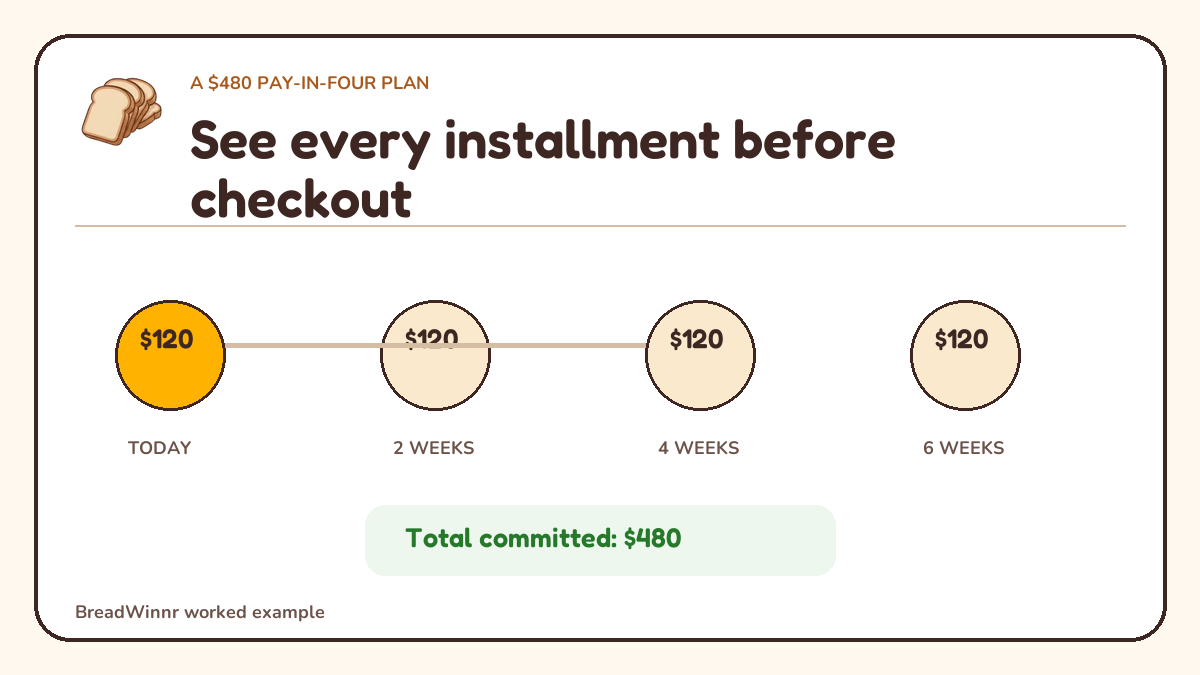
This worked pay-in-four example costs $480. The provider takes $120 at checkout and schedules three more $120 payments every two weeks. The full $480 is committed even though only $120 has left checking.
Write the merchant, original price, provider, remaining balance, funding account, and all due dates in one tracker. A phone calendar can flag withdrawals, while Google Sheets can total the commitments across providers.
Stack the dates before approving another plan
A second purchase has four $75 installments. If its dates overlap the $120 plan, two pay periods require $195. Looking at either app alone hides the combined withdrawal.
| Pay period | Plan A | Plan B | Total due |
|---|---|---|---|
| Checkout week | $120 | $0 | $120 |
| Two weeks later | $120 | $75 | $195 |
| Four weeks later | $120 | $75 | $195 |
| Six weeks later | $120 | $75 | $195 |
| Eight weeks later | $0 | $75 | $75 |
Choose a funding rule before checkout
The safest cash-flow method reserves the full $480 on purchase day, even though withdrawals happen later. If that is not possible, each future $120 must fit in the budget before its due date alongside essential expenses and existing plans.
Do not count the checking balance as available when part of it is committed to installments. Give the unpaid amount a named category. Autopay convenience does not guarantee that the funding account will have enough cash.
Check fees, returns, and missed payments
Read the plan terms for late fees, overdraft risk, credit reporting, dispute procedures, and return timing. CFPB says missed payments can lead to late fees, account freezes, collection activity, and possible credit consequences depending on the provider and product.
A retailer return and an installment schedule may resolve on different timelines. Keep the scheduled cash reserved until the provider confirms the adjustment. Save the order, return, and plan confirmations rather than assuming the next debit will stop.
Frequently asked questions
How does a typical pay-in-four plan work?
The first payment is usually due at checkout, followed by three payments at two-week intervals over about six weeks. Confirm the actual schedule and terms for your provider.
Should I budget the full BNPL purchase immediately?
Yes. Record the full obligation when you buy. Reserving the whole unpaid balance provides the clearest protection, even though the provider withdraws it in smaller installments.
How do I track multiple installment plans?
Use one list with every merchant, provider, remaining balance, due date, amount, and funding account. Total payments by payday so overlapping plans become visible.
Is an interest-free BNPL plan free?
Not always. Review late fees, overdraft exposure, return handling, and any product-specific charges. Even a zero-interest plan creates fixed future withdrawals.
What happens if I miss a BNPL payment?
Consequences vary, but CFPB notes possible late fees, frozen accounts, collection activity, and credit effects. Contact the provider before the due date when payment is at risk.
What should I do with installments after a return?
Keep the money reserved until the retailer and provider confirm the refund and revised schedule. Save both confirmations and verify the funding account before the next scheduled debit.
Sources and review notes
The calculations and scenarios in this guide are original BreadWinnr worked examples. We recalculated each example and checked that its parts match the stated total. Official sources support the financial concepts. Forum links document the reader problem that prompted the guide and are not treated as financial authority.
- CFPB: Buy Now, Pay Later market trends and product structure
- CFPB: What happens after a missed BNPL payment
- CFPB: Consumer use of Buy Now, Pay Later, 2025 report
- Reddit discussion: Reasons to avoid or use buy now, pay later
Read our research, testing, corrections, and source policy.
This guide provides general financial education. It does not account for your complete financial, tax, legal, or contractual situation.
Make the example yours.
Use the 50/30/20 budget calculator to try a different starting point.
Open the calculator