
Categorize the purchase when it happens. Later, record the credit card payment as a transfer from checking to the card account, not as another grocery, travel, or shopping expense. The purchase changes spending once; the payment changes which account holds the debt and cash.
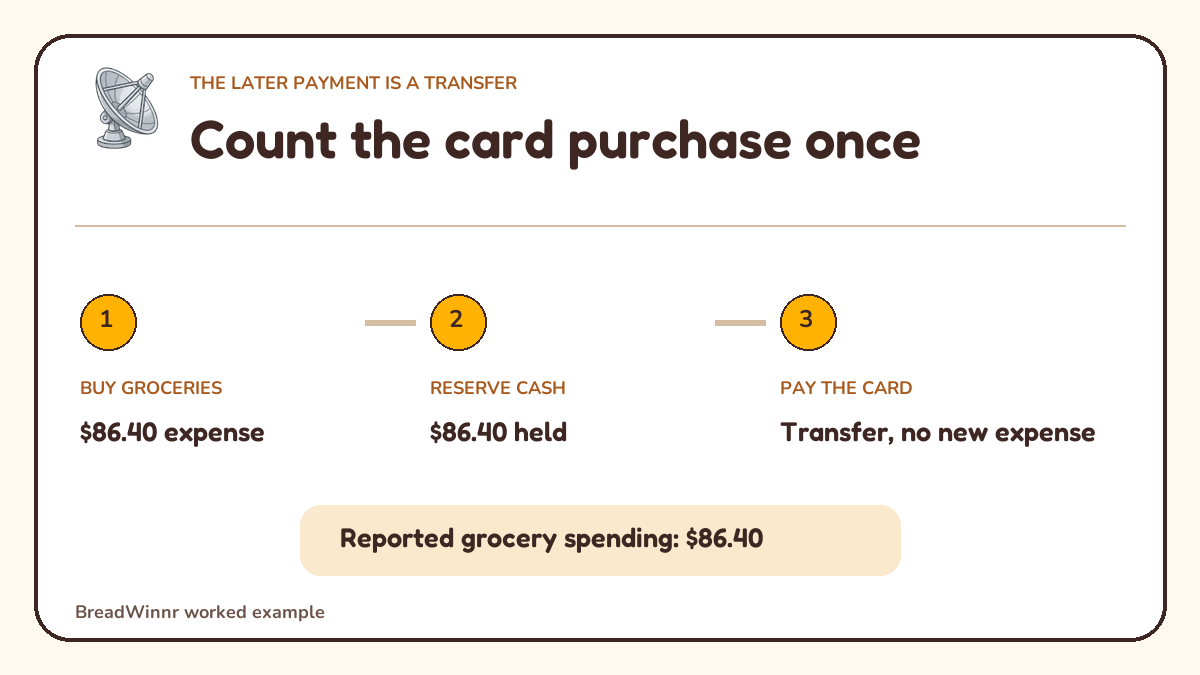
People often import both the card purchase and the checking-account payment, then categorize both as spending. The resulting report can show $172.80 of groceries for one $86.40 purchase. This guide follows the money through both accounts.
Start here: a practical action plan
- Confirm that every card purchase has one spending category.
- Reserve checking cash for each funded card purchase.
- Record the checking payment and card inflow as one transfer.
- Reconcile checking, the card, and the payment reserve after the payment posts.
- Categorizing the original purchase and the payment as the same expense.
- Deleting the card purchase instead of correcting the payment type.
- Treating interest or fees as transfers even though they are new costs.
Follow one purchase from swipe to payment
In this worked test, an $86.40 grocery purchase is entered in the credit card account and assigned to Groceries. The budget reports $86.40 of grocery spending and reserves $86.40 of checking cash for the future card payment.
When the card bill is paid, checking falls by $86.40 and the card balance falls by $86.40. Net worth does not change at that moment because cash and debt fall together. Categorizing the payment as groceries would create $172.80 of reported grocery spending from one basket.
Record the payment as a transfer
In software with linked accounts, select the card account as the payment destination or match the imported checking outflow with the imported card inflow. The transaction may display as two account entries, but together they describe one transfer.
| Event | Account change | Budget category |
|---|---|---|
| Buy groceries | Card debt rises $86.40 | Groceries: $86.40 spent |
| Reserve payment cash | No bank transaction | Card payment: $86.40 available |
| Pay card | Checking and card each fall $86.40 | Transfer, no new expense |
Find the duplicate without deleting real spending
Open the spending report and click the suspicious category total. If the purchase and card payment both appear, change the payment to a transfer. If there are two identical purchase entries, compare date, amount, status, and merchant before matching or removing one.
Do not delete the original card purchase just to make the report smaller. It documents where the money went. Reconcile checking and the card separately after the correction. Both balances should match the financial institutions.
Keep true card costs as expenses
Interest, annual fees, late fees, and cash-advance fees are new costs. Categorize them once in the card account, then reserve cash to pay them. A $24 interest charge increases the card balance and spending by $24. The later $24 payment remains a transfer.
This method does not assume the card is paid in full. It separates purchase activity, financing costs, and payments so the report remains useful. If the payment reserve is smaller than the card balance, the difference is existing debt that still needs its own payoff plan.
Frequently asked questions
Does paying a credit card count as an expense in a budget?
The payment itself is a transfer when the purchases were already categorized. It moves cash from checking and reduces card debt. The original purchases, interest, and fees are the expenses.
Why did my spending double after I paid the card?
The purchase and payment were probably assigned to spending categories. Keep the purchase in its category and change the payment to a transfer between checking and the card account.
How should I categorize credit card interest?
Record interest as a new expense in a category such as Credit Card Interest. It increases the card balance. The payment that later covers it is still a transfer.
What if the card payment appears twice after account import?
Compare the checking outflow and card inflow. They are the two sides of one transfer and should be linked or matched. Remove an entry only after confirming it is an actual duplicate.
Does a card payment change net worth?
A normal payment reduces cash and debt by the same amount, so it does not change net worth by itself. Purchases and interest reduced net worth when they occurred.
What if my card balance is larger than the money reserved to pay it?
The gap is unfunded card debt or a recording error. Reconcile the account first, then assign available cash to a card payoff category without pretending the assignment is new spending.
Sources and review notes
The calculations and scenarios in this guide are original BreadWinnr worked examples. We recalculated each example and checked that its parts match the stated total. Official sources support the financial concepts. Forum links document the reader problem that prompted the guide and are not treated as financial authority.
- CFPB: Credit card statements and payment information
- Reddit discussion: Are credit card transactions double counted?
- Reddit discussion: Credit card payment deductions duplicated
Read our research, testing, corrections, and source policy.
This guide provides general financial education. It does not account for your complete financial, tax, legal, or contractual situation.
Make the example yours.
Use the 50/30/20 budget calculator to try a different starting point.
Open the calculator