
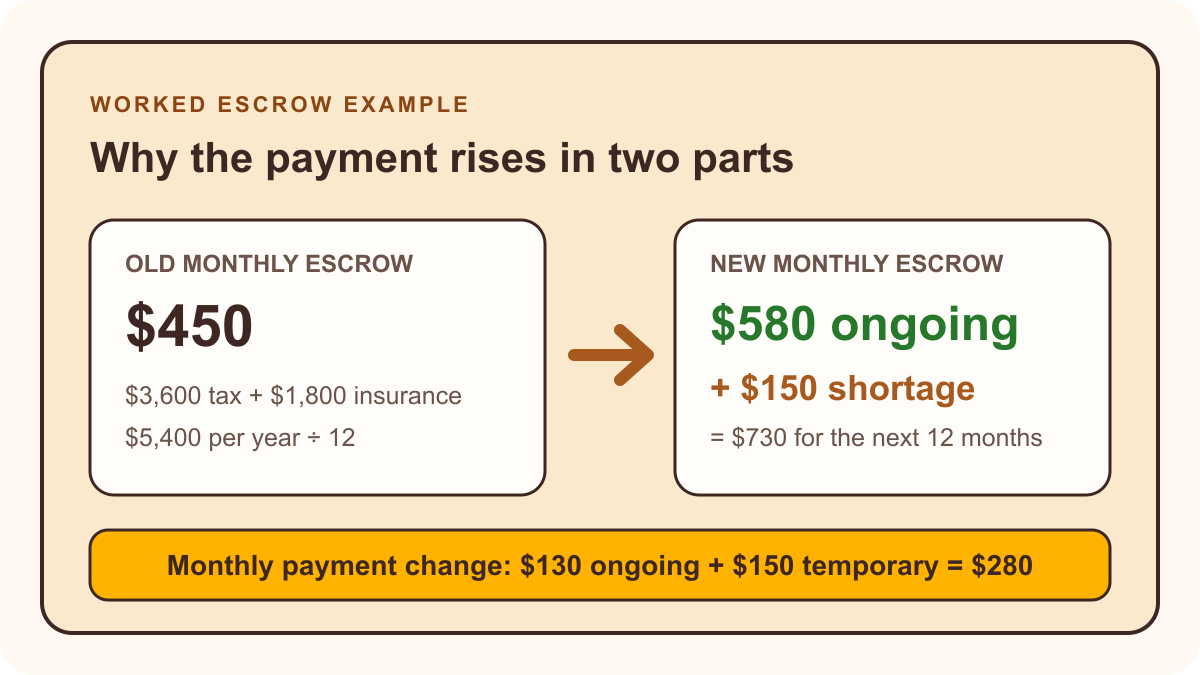
A mortgage payment can rise for two separate escrow reasons at once. The servicer may collect more each month for newly estimated property taxes and insurance, then add a temporary amount to repay last year’s shortage. In this worked example, ongoing escrow rises by $130 a month and a $1,800 shortage adds $150 for 12 months, producing a $280 monthly increase.
Homeowner forums repeatedly show the same confusion: paying the stated shortage in a lump sum does not necessarily restore the old mortgage payment. The shortage covers a past gap, while higher projected taxes and insurance still raise the ongoing escrow deposit.
Start here: a practical action plan
- Open the annual escrow statement and separate principal and interest, projected escrow, shortage repayment, and any cushion.
- Compare the projected property tax and insurance figures with the actual tax bill and insurance declaration.
- Recalculate the ongoing monthly escrow and temporary shortage amount, then compare their sum with the payment notice.
- Ask the servicer for the payment under each available shortage option and update the housing budget before the new payment date.
- Assuming a fixed mortgage rate guarantees a fixed total monthly payment.
- Expecting a lump-sum shortage payment to remove a separate increase in future taxes and insurance.
- Using most of an emergency reserve before confirming the exact monthly payment that would remain.
Separate principal and interest, new escrow, and shortage repayment
A fixed-rate mortgage can still have a changing total payment. Principal and interest may stay fixed while the escrow portion changes because the servicer expects to pay different property tax, homeowners insurance, mortgage insurance, or other permitted escrow charges.
A shortage is a backward-looking gap between what the escrow account collected and what it needed. The new base escrow deposit is forward-looking. A servicer can therefore collect both a higher ongoing amount and a temporary shortage repayment during the same year. Treating the entire increase as one unexplained number makes the statement harder to audit.
Read the annual escrow analysis in a fixed order
Start with the annual escrow statement, not only the payment-change notice. CFPB explains that most borrowers with escrow accounts receive an annual statement showing account history and projected activity. Find the actual disbursements for taxes and insurance, the new projected disbursements, the lowest projected balance, the shortage or surplus, and the servicer’s repayment option.
Then compare the property tax amount with the local tax bill and the insurance amount with the renewal declaration. Check whether mortgage insurance or another charge is also included. If a number is wrong, call the servicer with the source document in front of you. Keep notes with the date, representative, amount discussed, and promised next step.
- Confirm the old annual tax and insurance amounts.
- Confirm the new projected annual amounts.
- Locate the stated shortage and any cushion.
- Identify how many months the shortage repayment covers.
- Add the components and compare them with the new payment notice.
Work through a $280 monthly increase
This hypothetical mortgage has $1,420 of monthly principal and interest. The old escrow estimate was $3,600 of property tax plus $1,800 of insurance, or $5,400 a year. Dividing by 12 gives a $450 monthly escrow deposit and an old total payment of $1,870.
For the new year, projected property tax is $4,800 and insurance is $2,160. Their $6,960 annual total requires $580 a month, which is $130 above the old ongoing escrow amount. The analysis also identifies a $1,800 shortage. Spreading that shortage across 12 payments adds $150 a month. The new total is $1,420 principal and interest plus $580 ongoing escrow plus $150 shortage repayment, or $2,150.
| Payment component | Old monthly amount | New monthly amount | Change |
|---|---|---|---|
| Principal and interest | $1,420 | $1,420 | $0 |
| Ongoing escrow | $450 | $580 | +$130 |
| Shortage repayment | $0 | $150 | +$150 |
| Total payment | $1,870 | $2,150 | +$280 |
Understand what a lump-sum shortage payment changes
If the servicer offers a lump-sum option and applies $1,800 to the shortage, the temporary $150 line can disappear. The payment in this example would become $2,000: $1,420 of principal and interest plus $580 of ongoing escrow. It would still be $130 above the old payment because the projected bills remain higher.
Before sending a lump sum, ask the servicer for the exact payment that would remain afterward and when the change would take effect. Compare that answer with the monthly option and your cash reserves. Using most of an emergency fund to remove an interest-free monthly catch-up can weaken the household’s ability to handle another urgent cost. The right choice depends on the loan documents, servicer options, cash flow, and reserves.
Check the cushion without assuming it is the shortage
Federal escrow rules generally permit a cushion of up to one-sixth of estimated annual escrow disbursements, which is two months, unless a smaller amount applies under state law or the mortgage documents. The cushion is a required low-balance target, not a second property tax bill.
In the worked example, two months of the new $580 ongoing escrow equals $1,160. That does not mean the servicer adds $1,160 to every annual bill. The escrow projection should show the month-by-month balance and the required low point. If the analysis appears to use the wrong tax, insurance, payment date, or cushion, CFPB explains that a borrower can send a written notice of error if the servicer does not fix the issue by phone.
Build a housing-change buffer before the next analysis
After checking the current notice, record the new base housing cost separately from the temporary catch-up. In this example, use $2,000 as the ongoing payment and mark the extra $150 with its expected final month. Do not assume the total will fall automatically until the servicer issues the next analysis.
Review the property tax portal after reassessment and the insurance renewal before the servicer’s next annual review. If either bill changes, update a housing buffer instead of waiting for the payment notice. New construction, a recently renovated home, an expiring exemption, and a large insurance renewal change deserve extra attention because the prior estimate may not represent the next full year.
Frequently asked questions
Why did my fixed-rate mortgage payment increase?
The fixed rate applies to principal and interest. Your total payment can still rise when escrowed property taxes, homeowners insurance, mortgage insurance, or a shortage repayment changes. Compare each component on the annual escrow statement.
What is a mortgage escrow shortage?
An escrow shortage means the projected account balance falls below the amount the servicer requires to pay escrowed bills and maintain any permitted cushion. It commonly follows higher taxes or insurance, an earlier estimate that was too low, or a payment-timing change.
Why is my payment still higher after I pay the escrow shortage?
A lump-sum shortage payment covers the past gap. It does not erase higher future property tax or insurance estimates. In the worked example, paying the $1,800 shortage removes $150 a month, but the ongoing escrow deposit remains $130 above the old amount.
How do I check an escrow analysis for errors?
Compare projected tax and insurance amounts with the actual tax bill and insurance declaration, confirm all listed disbursement dates, identify the shortage and cushion separately, and add the monthly components. Ask the servicer to explain any mismatch in writing.
Should I pay an escrow shortage in a lump sum?
Compare the exact remaining payment, the monthly repayment option, and the cash reserve you would give up. A lump sum may reduce monthly pressure, but it may not reduce the ongoing escrow increase and can leave less cash for emergencies.
Will the mortgage payment fall after the shortage is repaid?
The temporary shortage portion may end after the stated repayment period, but taxes, insurance, mortgage insurance, and future escrow analyses can change the payment again. Use the servicer’s next analysis rather than assuming a specific future amount.
Sources and review notes
The calculations and scenarios in this guide are original BreadWinnr worked examples. We recalculated each example and checked that its parts match the stated total. Official sources support the financial concepts. Forum links document the reader problem that prompted the guide and are not treated as financial authority.
- CFPB: Why a monthly mortgage payment can change
- CFPB: Federal escrow account rules in Regulation X
- CFPB: Limits and annual statements for mortgage escrow accounts
- CFPB: Mortgage servicer rules and notices of error
- Reddit discussion: Escrow shortage and a $300 monthly increase
- Reddit discussion: Why paying the shortage did not restore the old payment
- Reddit discussion: A large escrow-driven mortgage payment increase
Read our research, testing, corrections, and source policy.
This guide provides general financial education. It does not account for your complete financial, tax, legal, or contractual situation.
Make the example yours.
Use the 50/30/20 budget calculator to try a different starting point.